How Illinois Weather Attacks Your Deck
Chicago-area weather is genuinely brutal on outdoor structures. O’Hare International Airport — a standard climate benchmark for the region — logs roughly 56 freeze-thaw cycles per year. That means wood fibers are expanding and contracting more than once a week on average through winter and early spring. Every cycle that water infiltrates a board, freezes, and expands drives that wood a little further toward cracking, warping, and rot.
Summers compound the problem. High humidity through July and August keeps wood saturated when it’s not baking under direct sun. The combination of moisture absorption and UV exposure breaks down protective finishes faster in Illinois than in drier climates. Homeowners who skip or delay refinishing often find that what looked like surface weathering is actually structural degradation by the time they get around to it.
This climate context matters because it changes the math on every other comparison — lifespan, maintenance frequency, and long-term cost. A wood deck in Phoenix faces different stresses than a wood deck in Arlington Heights, and the gap in performance between wood and composite is wider here than almost anywhere in the country.
Lifespan: How Long Will Each Material Actually Last?
A well-maintained pressure-treated wood deck in Illinois typically lasts 10 to 15 years before boards start failing structurally. That’s with consistent upkeep — sanding, staining, and sealing on a regular schedule. Let maintenance slip for a season or two, and you’re looking at early board replacement, fastener corrosion, and potentially substructure damage.
Composite decking, particularly capped composite boards with a protective polymer shell, carries manufacturer warranties ranging from 25 to 50 years. The capping process is what makes the difference in a harsh climate: it seals the wood fiber core against moisture, so freeze-thaw cycling has far less to work with. The boards don’t absorb water the way natural wood does, which means they resist the cracking and warping that kills wood decks prematurely in this region.
That lifespan gap — roughly 15 years of useful life for wood versus 25 to 50 for composite — is the single most important data point in this comparison. Everything else, including cost, flows from it.
Maintenance: What You’re Signing Up For
Wood decks need annual or biennial attention. At minimum, that means a thorough cleaning, inspection for soft spots and fastener failure, light sanding to open the grain, and a fresh coat of stain or sealant. If you hire this out — which most homeowners eventually do — you’re looking at several hundred to over a thousand dollars per service depending on deck size and local labor rates.
Over a 20-year period, that maintenance cost adds up fast. And unlike a one-time expense, it’s recurring. Miss a year and the damage accelerates. Miss two years in Illinois weather and you’re often looking at partial board replacement on top of refinishing costs.
Composite decking maintenance is a different story. An occasional power wash — once or twice a year — is genuinely all most composite decks need. There’s no staining, no sealing, no sanding. The surface holds up through Illinois winters without special treatment. Manufacturers of quality capped composite products like Trex back this up with warranties that explicitly cover fading, staining, and structural integrity for decades.
Composite Deck Installation: What the Process Looks Like
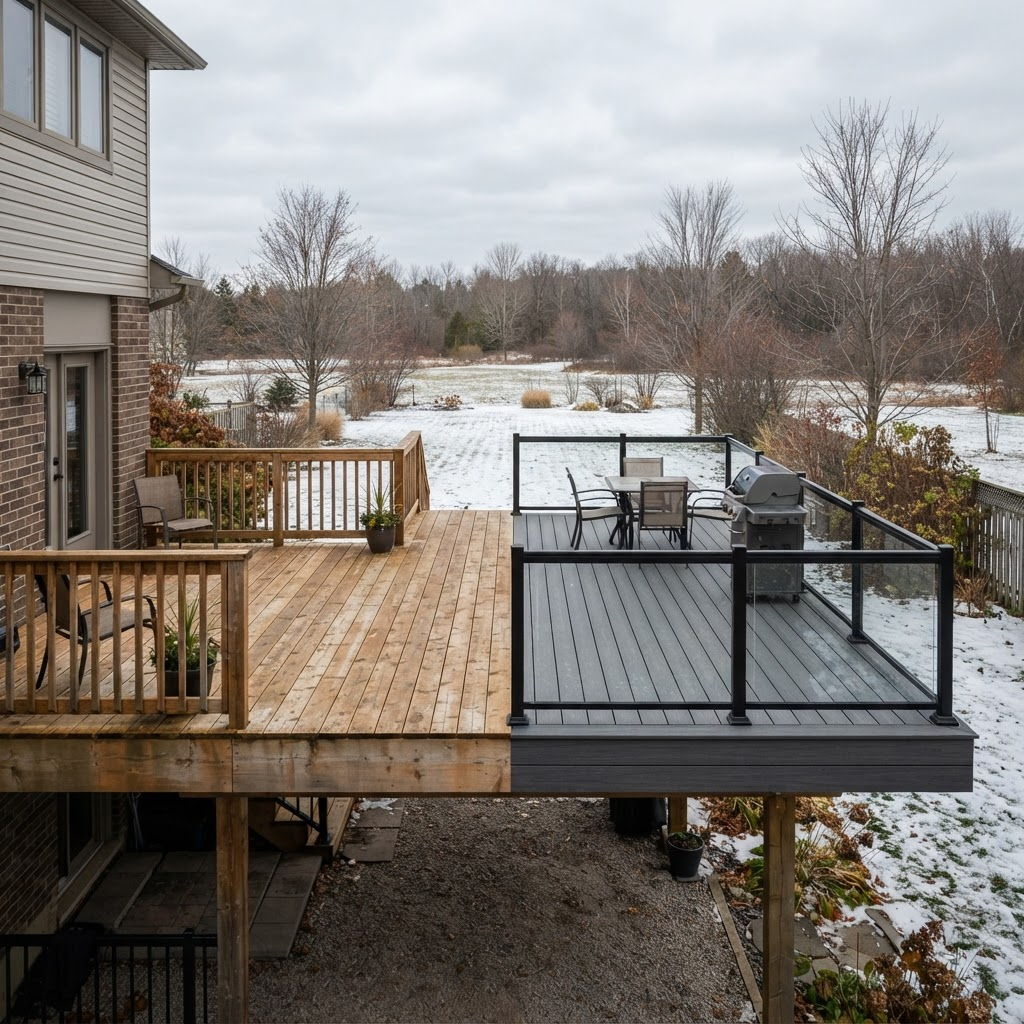
Installing composite decking involves more precision than most homeowners expect. The substructure — joists, beams, and posts — still requires pressure-treated lumber or steel framing. Composite boards go on top of that framework using hidden fastener systems that allow for thermal expansion without surface screws showing. Spacing requirements are tighter than wood to allow airflow and prevent moisture trapping.
A professional composite deck installation accounts for all of this upfront, including Illinois-specific considerations like frost depth for footings and proper drainage slope. Getting the foundation right matters as much as the decking material itself — a premium composite surface on a poorly built frame won’t perform the way it should.
Wood Deck Installation: What It Involves
Pressure-treated pine is the standard entry point for wood decks, though cedar and redwood remain popular for their natural appearance and resistance to insects. Each species behaves differently and requires different finishing approaches. Cedar, for example, needs to dry for several months after installation before stain adheres properly — a detail that catches some homeowners off guard.
A proper wood deck installation includes correct fastener selection, proper board spacing for drainage, and surface treatment timed to the wood’s moisture content. In Illinois, this also means accounting for freeze-thaw movement in the framing design. Wood expands and contracts more than composite, so connections need to allow for that movement without loosening over time.
Replacing an Aging Deck: What to Know Before You Start
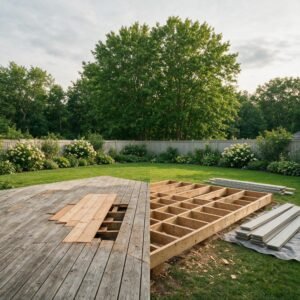
Many homeowners facing this decision aren’t building new — they’re replacing a deck that’s reached the end of its life. If your existing deck is showing significant board deterioration, soft spots near ledger connections, or signs of rot at post bases, you’re likely looking at full deck replacement rather than repair. It’s worth having a contractor assess the substructure before assuming it can be reused.
In many cases, the framing and footings from an older wood deck are reusable if they’re structurally sound, which reduces the total cost of switching to composite. This is one of the most common scenarios where homeowners who started with wood end up choosing composite for the rebuild — they’ve already lived through the maintenance cycle and want out of it.
Summer Heat: The Composite Caveat
There’s one area where composite has a real limitation: surface temperature on hot days. Dark composite boards in direct July sun can reach surface temperatures significantly higher than natural wood. This is a genuine comfort issue, not just a technical footnote.
The practical solution is straightforward. Lighter board colors — grays, tans, and lighter browns — absorb substantially less heat than dark espresso or charcoal tones. Adding a pergola or shade structure over the deck solves the problem entirely and extends the usable hours during peak summer afternoons. Most manufacturers publish heat data for their color lines, so you can make an informed choice during selection. Research from the Department of Energy on surface heat absorption confirms that color and reflectivity have a major impact on how hot outdoor surfaces get — the same principle applies to decking.
The 20-Year Cost Comparison
This is where the conversation shifts for most homeowners. Wood decking costs less upfront — typically $15 to $25 per square foot installed versus $30 to $45 or more for composite, depending on material grade and complexity. That gap looks significant when you’re writing the initial check.
Run the numbers over 20 years and the picture changes. A 400-square-foot wood deck at $20 per square foot costs $8,000 to build. Add biennial refinishing at $600 per session — that’s roughly $6,000 over 20 years. Factor in one or two board replacement jobs and the total lands somewhere between $15,000 and $18,000. And at year 15, you may be replacing the whole deck anyway.
The same 400-square-foot composite deck at $35 per square foot costs $14,000 upfront. Maintenance over 20 years: minimal. No refinishing, occasional cleaning. Total cost over 20 years: close to the original installation price. The composite deck is still performing at year 20 while the wood deck may already be gone. Over a long enough horizon, composite is almost always the lower-cost option in Illinois — even though it costs more on day one.
Which Material Is Right for Your Situation?
Wood makes sense when budget is the primary constraint and you’re genuinely committed to the maintenance schedule. It’s also a reasonable choice for secondary structures — a small backyard platform or a deck attached to a rental property where long-term ROI is less of a priority. Natural wood has an aesthetic that some homeowners prefer and that composite, despite improving significantly, hasn’t fully replicated.
Composite makes sense for primary outdoor living spaces where you want the deck to perform without annual attention. If you’re building something you plan to use heavily, something that adds real value to your home, and something you don’t want to refinish every other year in Illinois weather, composite is the stronger long-term investment. The upfront cost premium pays for itself through avoided maintenance and a lifespan that often doubles what wood delivers in this climate.
The composite deck vs wood deck Illinois question doesn’t have a single universal answer, but the Illinois climate tilts the math firmly toward composite for most homeowners investing in a primary outdoor space. Fifty-six freeze-thaw cycles a year is a lot of stress for unsealed or under-maintained wood. The lifespan gap is real, the maintenance difference is significant, and the 20-year cost comparison almost always favors composite once you account for refinishing, repairs, and replacement timing.That said, wood isn’t wrong for every situation. Tighter upfront budgets, secondary structures, and homeowners who genuinely enjoy hands-on deck maintenance all represent cases where wood remains a reasonable choice. The key is going in with accurate expectations rather than discovering mid-project that the maintenance commitment was more than anticipated.Whatever direction you’re leaning, getting a professional assessment of your specific yard, usage patterns, and budget makes the decision easier. The right material is the one that fits your home and your life — not just the one that looks good in a brochure.