What a Big-Box Deck Kit Actually Includes
Walk through the outdoor lumber section of any major home improvement store and you’ll find deck kits marketed as complete solutions. Most include composite or pressure-treated decking boards, some structural hardware, and occasionally railing components. The price ranges widely depending on size and brand, but a kit for a modest 12×16 deck surface often runs $1,500 to $4,000 in materials alone.
That sounds manageable until you read the fine print. Most kits are designed around the decking surface — the part you walk on. They assume you’re handling footings, framing, ledger attachment, flashing, and permits separately. Those aren’t small details. They’re the difference between a deck and a pile of boards on the ground.
Some kits don’t include railings at all, or offer them as a separate purchase that can add $50 to $100 per linear foot. If your deck is elevated more than 30 inches off the ground, railings aren’t optional — they’re required by code in virtually every Illinois municipality.
The Line Items the Kit Doesn’t Cover
Here’s where the real composite deck installation cost in Chicago starts to surface. Let’s go through the most common missing pieces one by one.
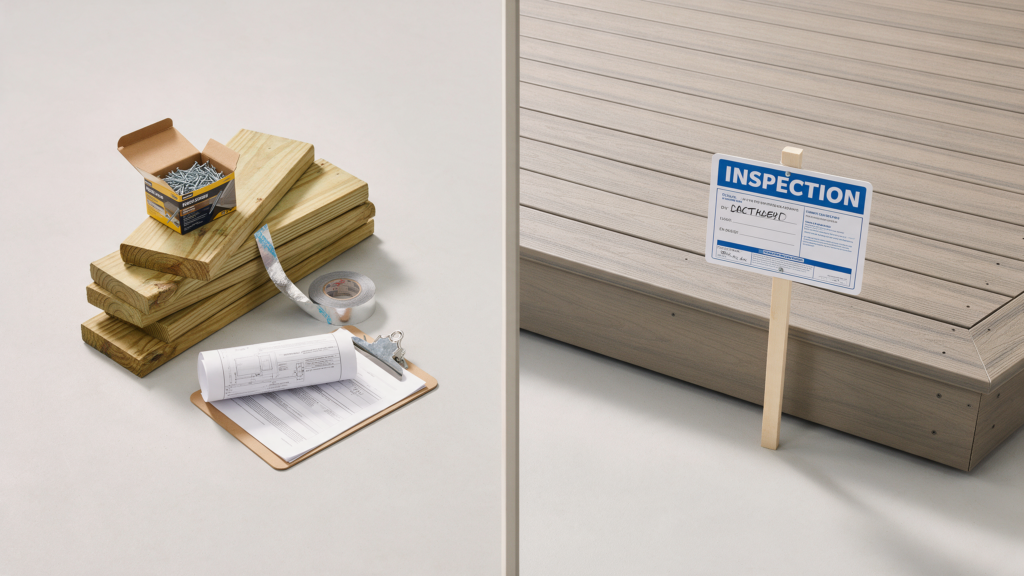
Permits. Arlington Heights requires a building permit for decks. You can confirm the specific requirements through the Village of Arlington Heights Building and Inspections department. Permit fees vary by project size and scope, but the permit process also triggers inspections — which is the mechanism that catches dangerous construction before someone gets hurt. Skipping a permit doesn’t just risk a fine; it can result in a stop-work order or a requirement to tear down unpermitted work at your own expense.
Frost-line footings. This is the big one in northern Illinois. The frost line in the Chicago area runs approximately 42 inches deep, and the International Residential Code requires footings to extend below it. A deck footing that doesn’t reach that depth will heave during freeze-thaw cycles, shifting the structure, cracking boards, and eventually making the deck unsafe. Digging, forming, and pouring concrete footings correctly requires either significant DIY experience or rented equipment — and the cost adds up fast.
Ledger flashing. A ledger board is what attaches your deck to your house. Improper ledger attachment is one of the most frequently cited causes of deck structural failure. It’s not enough to bolt the ledger to the rim joist; the connection must be properly flashed to prevent water infiltration behind the ledger, which leads to rot in the house’s band joist over time. Proper flashing requires the right materials, the right overlap sequence, and in many cases, pulling back existing siding. This is not a kit component.
Fasteners and hardware. Composite decking requires specific fasteners — often hidden clip systems — that are compatible with the board manufacturer’s specifications. Using the wrong fasteners voids warranties on most composite products. A quality hidden fastener system for a mid-sized deck adds $200 to $600 to the material cost beyond what many kits include.
What Does Professional Composite Deck Installation Cost in Chicago?
Nationally, installed composite decking runs roughly $15 to $32 per square foot according to HomeAdvisor’s cost data, and Chicago-area labor rates typically sit at or above that national range. For a 200-square-foot deck, that’s a professional installed price of $3,000 to $6,400 or more before accounting for site complexity, railing specifications, or custom features.
That range is wide because projects are genuinely different. A ground-level deck on flat terrain with a simple rectangular layout costs less than an elevated deck with multiple levels, built-in benches, or complex railing systems. The honest answer is that you need two or three local quotes to get a real number for your specific project. Any contractor who gives you a firm price over the phone without visiting your site is guessing.
What the professional price includes — when you’re working with a contractor like Direct Remodeling — is permit pulling, frost-line footing installation, proper ledger attachment and flashing, materials selection, and warranty-compliant installation of the composite system. That’s not markup for its own sake. Those are real labor hours and real material costs that exist whether you pay a pro or handle them yourself.
The DIY Hidden Cost Calculation
Run the actual numbers on a DIY composite deck and it looks different than the initial kit price suggests. Here’s a realistic breakdown for a basic 200-square-foot deck in the Chicago suburbs:
- Deck kit (boards and surface hardware): $1,500–$4,000
- Permit fees: $200–$600 depending on municipality
- Concrete and footing forms: $300–$700
- Post hardware, joist hangers, structural screws: $200–$500
- Ledger flashing materials: $100–$300
- Railing system (if not included): $800–$2,500
- Tool rental (post hole digger, saw, level, etc.): $150–$400
Add that up and a DIY project that looked like $2,000 on the sales floor can reach $5,000 to $9,000 in actual out-of-pocket costs — and that’s before accounting for your time, any mistakes that require additional materials, or the cost of a structural inspection if something needs to be corrected.
Composite vs. Wood: The Total Ownership Angle
One more cost comparison worth making: composite versus pressure-treated wood, whether DIY or professionally installed. Wood is cheaper upfront. A pressure-treated wood deck costs less per square foot in materials, which is why wood deck installation remains a popular choice for budget-focused homeowners.
But wood requires maintenance. Staining or sealing every two to three years runs $500 to $1,500 per treatment depending on deck size and whether you DIY or hire out. Over a 15-year period, a wood deck that was cheaper to build can easily exceed the lifetime cost of a composite deck that requires only occasional cleaning. Composite boards don’t rot, don’t splinter, and don’t absorb water the way wood does — which matters considerably in a climate with Chicago’s freeze-thaw cycles and humid summers.
If you’re evaluating options for an existing structure, our deck replacement guide covers when repair makes sense versus a full replacement, and how to factor material choice into that decision.
Permit and Safety Reality in Arlington Heights
Unpermitted decks create real problems. An inspector who spots an unpermitted structure during a neighbor complaint or pre-sale inspection can order it brought into compliance — or taken down. The cost of retroactive permitting and structural correction often exceeds what the permit would have cost upfront.
Beyond the permit issue, structural failures on decks are a documented safety concern. The issues are almost always the same: footings that didn’t reach the frost line, ledger connections that weren’t properly fastened or flashed, or railings that weren’t anchored to meet load requirements. These aren’t hypothetical risks. They’re the reasons building codes exist.
Working with a licensed contractor means those inspections happen during construction, not after a failure. Direct Remodeling pulls permits for every deck project and manages the inspection process so homeowners don’t have to track that paperwork themselves.
Where the Kit Actually Makes Sense
To be fair: a big-box deck kit works reasonably well for certain situations. Ground-level platforms — sometimes called floating decks — that don’t attach to the house and stay below the railing-required height can be built without a ledger connection, which removes one of the major technical challenges. In some municipalities, low-profile freestanding decks also have a simpler permit path.
If you have genuine construction experience, the right tools, and a straightforward site, DIY composite installation is achievable. The honest caution is that the margin for error is real, and the consequences of structural mistakes in a Midwest climate compound over time in ways that aren’t always visible until a board gives way.
Getting a Real Number for Your Project
The most useful thing you can do before making any decision is get two or three quotes from local contractors who will visit your site and give you a written scope. That scope should specify footing depth, ledger attachment method, flashing detail, composite product and warranty, railing system, and permit responsibility.
Compare that written scope against the actual cost of the DIY path — including all the line items above — and you’ll have a real apples-to-apples comparison. For many homeowners in the Chicago suburbs, the professional installed price lands closer to the DIY total cost than the kit sticker price suggested. And the professional path comes with warranty coverage, code compliance, and none of the weekend labor.
Direct Remodeling specializes in composite deck installation throughout Arlington Heights and the Cook County suburbs. Every project includes permit management, frost-line footings, and proper ledger flashing as standard — not add-ons.
The deck kit price is real. It’s just not the whole project cost, and in most cases it’s not even the majority of it. Once you add permits, proper footings, ledger flashing, railings, and fasteners, the DIY path gets more expensive and more technically demanding than the box suggests. That’s not a reason to never go DIY — it’s a reason to build an accurate budget before you commit to either path.Composite material costs more upfront than pressure-treated wood, but the maintenance savings over 10 to 15 years close that gap for most homeowners. Add the structural requirements that apply regardless of who builds the deck, and the composite deck installation cost in Chicago is better understood as a range that depends heavily on site conditions and scope — not a number you can read off a pallet.Get local quotes. Verify what’s included in the scope. Ask specifically about footing depth, ledger attachment, and who pulls the permit. Those three questions will tell you a lot about whether a contractor is pricing the whole job or just the surface.