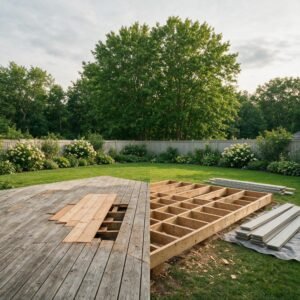
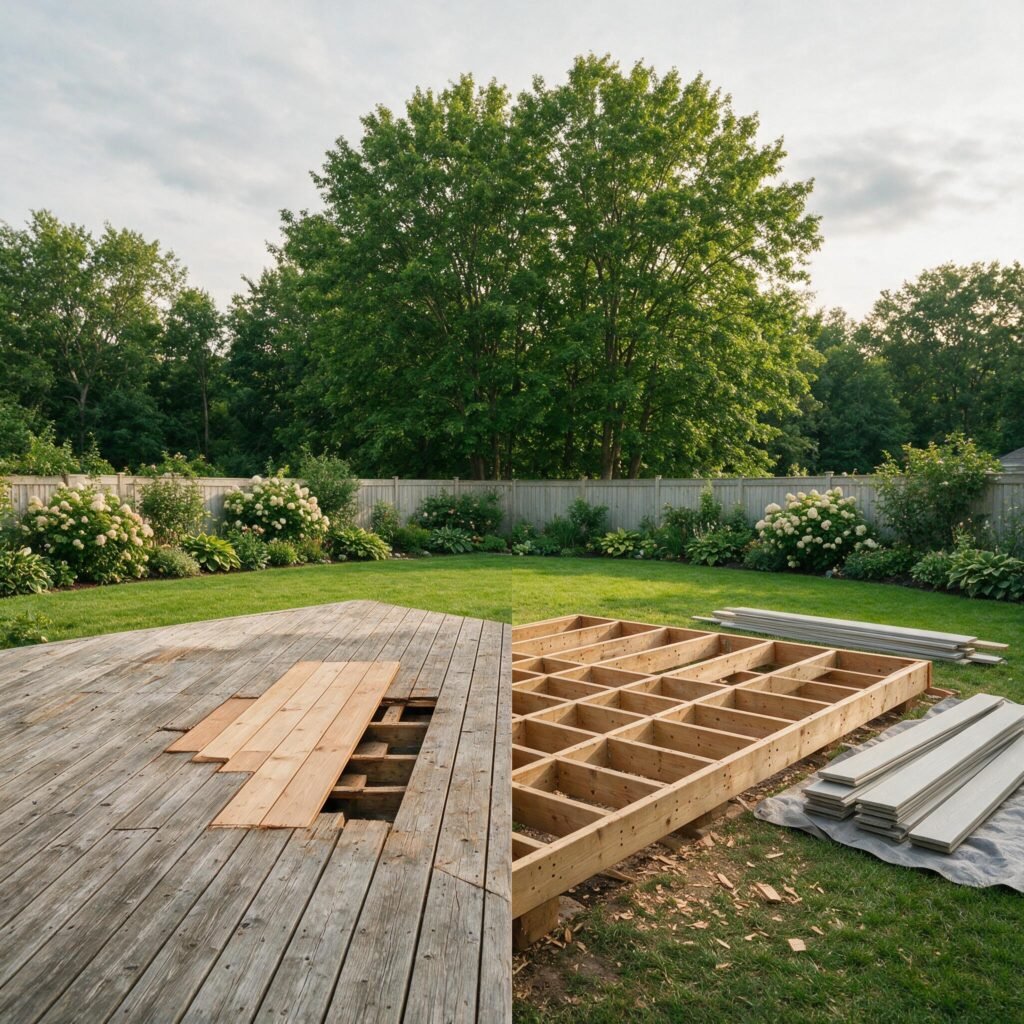
Start Underneath: The Screwdriver Test
Before you spend a dollar on repairs or get a single quote for replacement, do this first. Grab a flathead screwdriver and get under your deck. Press the tip firmly into the framing members — the joists, beams, and posts that hold everything up. You’re not just poking around. You’re applying real pressure.
If the screwdriver sinks in with little resistance — the way it might push into damp cardboard — that wood has lost its structural integrity. Rot has gone past the surface and into the core. At that point, repair is off the table. You can’t sister a new joist to a beam that’s rotting through, and you can’t put new decking over a frame that won’t hold load safely.
If the screwdriver leaves only a small indent and meets firm resistance, the framing is still sound. That’s the condition where repair makes sense. The test is simple, but it’s the most honest information you’ll get about what your deck is actually worth saving.
Check the Ledger Board First — Before Anything Else
The ledger board is the single most critical piece of your deck’s structure. It’s the board that attaches the deck directly to your house, and it carries a significant share of the deck’s load. When ledger boards fail, decks collapse — not gradually, but suddenly.
Look for three specific problems: rot in the ledger itself, any visible separation between the ledger and the house, and rusted or corroded fasteners at the connection point. Any one of these issues is serious. All three together means the deck is a liability, not an asset.
Here’s the hard truth: a rotted or separated ledger almost never gets patched. The right fix requires removing the old ledger, treating or repairing the band joist on the house, and re-attaching a new ledger with proper flashing and code-compliant hardware. That’s essentially the same labor and disruption as a full replacement — and once you’re doing that work anyway, keeping the rest of an aging deck rarely makes financial sense. The American Wood Council’s deck construction guide covers ledger attachment requirements in detail, and the standards have tightened considerably over the past decade.
How Illinois Freeze-Thaw Cycles Change the Math
Illinois homeowners deal with a climate that’s genuinely hard on wood structures. The freeze-thaw cycle — water penetrating wood fibers, freezing, expanding, thawing, and repeating — accelerates decay and structural failure faster than almost any other weathering pattern. A deck that might last 25 years in Atlanta or Phoenix often shows serious structural problems at 12 to 15 years in the Chicago suburbs.
Every winter, any moisture that’s worked its way into joints, end grain, or fastener holes expands. Fasteners loosen. Boards split. Concrete footings shift. By the time a deck looks bad on the surface here, the framing underneath has typically been under stress for years. This is why the surface appearance of an Illinois deck is almost always a lagging indicator of real structural condition — what you can see is usually behind what’s already happened below.
When you’re assessing an older wood deck in Cook County or the surrounding suburbs, assume the worst until the screwdriver test proves otherwise. The climate earns that skepticism.
Material Lifespan: Know What You’re Working With
Age context matters in the repair-or-replace decision. Understanding the expected lifespan of your decking material tells you how much useful life a repaired deck actually has left — and whether spending money on repairs makes sense at all.
- Pressure-treated lumber: 15–25 years with proper maintenance. Most common decking material in the Midwest.
- Cedar and redwood: 15–20 years. More naturally rot-resistant, but still vulnerable to freeze-thaw damage without consistent sealing.
- Composite decking: 25–30 years, with most manufacturers offering 25-year warranties. Resistant to moisture, insects, and UV degradation.
If your pressure-treated deck is 18 years old and you’re looking at significant repairs, you’re investing money in a structure that has, at best, a few years of useful life remaining. That calculus changes completely if the deck is only 8 years old with an isolated problem — a few rotted boards or a damaged post — and the framing is otherwise solid.
The Cost Rule of Thumb That Makes This Decision Simpler
Cost ratios cut through a lot of the uncertainty in the deck repair vs deck replacement decision. Here’s the framework: if your repair estimate comes in under 40–50% of what a full replacement would cost, repair makes sense — assuming the structure is sound. Once the repair estimate climbs toward 50–60% of replacement cost, replacement becomes the smarter investment. You’re spending nearly as much and still getting an aging structure at the end of it.
Get actual quotes for both before making a call. Repair estimates have a tendency to grow once work begins, especially on older decks where one rotted joist leads to another. A contractor who’s being honest with you will flag that risk upfront. If someone gives you a repair quote without getting under the deck to check the framing, that quote isn’t reliable.
Factor in the cost of doing nothing, too. A structurally compromised deck doesn’t stay marginal — it fails. And deck failures that result in injuries create homeowner liability exposure that far exceeds any repair or replacement cost.
When Repair Is the Right Answer
Repair makes clear sense in specific situations. The deck is relatively young — under 10 years for pressure-treated, under 8 for cedar. The framing passes the screwdriver test with solid resistance throughout. The ledger is secure, properly flashed, and the fasteners show no significant corrosion. The problems are isolated: a handful of damaged boards, a single post that took impact damage, surface-level splitting or checking that hasn’t compromised structural members.
In these cases, targeted repairs extend the deck’s life meaningfully and at a fraction of replacement cost. Good maintenance — cleaning, re-sealing, replacing damaged boards promptly — is the cheapest thing you can do for a structurally sound deck.
When Replacement Is the Right Answer
Replacement becomes the right call when the framing is soft, the ledger is compromised, the deck is at or past the end of its material lifespan, or when repair costs approach or exceed half of replacement cost. It’s also the right call when building codes have changed significantly since the original installation — older decks built before current railing height, baluster spacing, and ledger attachment standards were adopted sometimes can’t be brought up to code without essentially rebuilding them anyway.
Replacement is also the moment to reconsider what you want the deck to be. A 20-year-old pressure-treated deck that’s finally failing gives you the opportunity to build something that will last another 25–30 years with far less maintenance — and composite decking is the natural consideration at that point. No painting, no sealing, no annual sanding. The upfront cost is higher than pressure-treated, but the long-term cost of ownership over a 25-year period often comes out close or in composite’s favor once you factor in maintenance labor and materials.
The Permit Question: Don’t Skip It
Whether you repair or replace, check local permit requirements before work starts. In Illinois, deck replacement almost always requires a permit. Significant structural repairs — replacing ledger boards, footings, or primary framing — typically do as well. Most Chicago suburbs, including Arlington Heights, handle permitting through their own municipal building department; Cook County’s building and zoning department only has jurisdiction over unincorporated areas of the county. Either way, expect specific requirements for deck construction and major repairs, including inspections at key stages of the work
Unpermitted deck work creates problems when you sell the house. It also means no one has verified that the structure meets current safety standards — which matters a great deal if you’re spending money on something your family and guests will stand on.
The deck repair vs deck replacement decision comes down to three things: structural condition, material age, and cost ratios. Run the screwdriver test. Check the ledger carefully. Get quotes for both options and apply the 40–50% rule. In most cases, those three steps will make the right answer obvious.Illinois homeowners have to account for what freeze-thaw cycles do to wood over time. A deck that looks borderline fixable in May has usually been deteriorating through multiple winters, and the framing tells the real story. Surface repairs on a structurally failing deck don’t extend its life — they just delay the larger expense.If replacement is where you land, treat it as an opportunity rather than just a cost. The right decking material and a well-designed structure built to current code standards gives you 25 to 30 years of outdoor living space that holds up through Chicago winters without the maintenance burden that pressure-treated lumber demands.