What a Handyman Is — and Isn’t — Licensed to Do
The word “handyman” is not a licensed trade category in Illinois. There’s no state-issued handyman license, no required examination, and no mandatory insurance threshold. That doesn’t make every handyman unqualified — many are experienced tradespeople who left a specific industry and now do general repair work exceptionally well. But it does mean there’s no standardized floor on their training, insurance, or legal authority to perform certain types of work.
In Illinois, plumbing work must be performed by a licensed plumber under the Illinois Plumbing License Law. Electrical work on new circuits or panel changes requires a licensed electrician. In most Cook County municipalities, any work that alters plumbing, drainage, or the structure of a bathroom requires a building permit — and pulling that permit requires a licensed contractor. A handyman operating outside those boundaries isn’t just cutting corners. They’re working outside the law, and that liability lands on the homeowner.
Again, this isn’t a knock on handymen as a category. A skilled one is an asset. The issue is scope. When the scope of work includes moving a drain, installing a shower pan, adding a GFCI circuit, or waterproofing a wet area, the job has crossed into territory that requires licenses, permits, and inspections — not because bureaucrats invented extra steps, but because water damage and electrical failures in bathrooms are among the most costly and dangerous things that can happen in a home.
Where the Price Gap Actually Comes From
When a licensed bathroom contractor quotes a remodel, a portion of that number covers things that never show up on a handyman’s estimate — not because the handyman forgot them, but because they genuinely don’t apply to how that person operates. Understanding each line item helps you evaluate what you’re actually buying.
Permits and inspections. A licensed contractor pulls permits with the local municipality before work begins. In Arlington Heights and throughout Cook County, bathroom remodels involving plumbing or electrical changes require permits. The permit fee itself is modest, but the process requires submitting plans, scheduling inspections, and ensuring work meets current code. This protects you. An inspector verifies that your new shower drain is properly vented, that your GFCI outlets are correctly placed, and that waterproofing was applied before tile went down. That documentation also follows the house — a clean permit history is something buyers and their home inspectors look for.
Licensed plumbing and electrical. Licensed subcontractors or in-house licensed tradespeople cost more per hour than unlicensed labor. That’s not a markup — it’s the market rate for credentials, accountability, and insurance. A licensed plumber carries liability insurance tied to their license. If they create a leak, there’s a clear chain of responsibility and coverage.
Proper waterproofing. Waterproofing a shower or wet area correctly isn’t intuitive, and it isn’t cheap. Products like Schluter KERDI membrane or similar systems, properly applied over cement board or uncoupling membrane, add material and labor cost to any tile shower installation. Skip it or shortcut it, and water migrates behind the tile within two to three years — silently, invisibly, and expensively. Research from builders and inspectors consistently identifies improper waterproofing as one of the leading causes of hidden structural damage in bathroom renovations.
Liability insurance and workers’ comp. A licensed contractor carries general liability insurance and, if they have employees, workers’ compensation. If an uninsured worker gets hurt in your home, your homeowner’s policy is the first line of defense — and depending on your coverage, that’s a problem. General liability coverage means that if the contractor damages your home during the project, there’s a policy to back the repair.
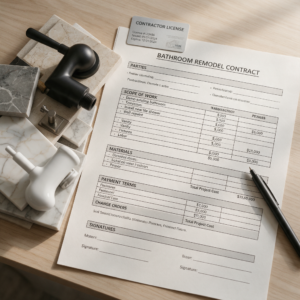
A written scope of work. Professional contractors document what they’re doing before they start. Every line of work, every material specification, every exclusion. This isn’t paperwork for its own sake — it’s the thing that prevents “scope creep” disputes and gives you recourse if the finished product doesn’t match what was discussed.
A workmanship warranty. Quality contractors stand behind their work with a written warranty. If the tile grout fails at eight months or the shower door leaks at the frame, a warranty gives you a defined path back to the contractor. Handymen rarely offer written warranties, and even when they do, enforcing one against an individual with no license on record is difficult.
The Real Risks of Skipping Licensed Work on a Bathroom
This is where the math gets uncomfortable. The handyman quote is lower today, but it may not be lower over the life of the project. There are three specific scenarios where the cheaper route becomes the more expensive one.
Unpermitted work at resale. When you sell your home, buyers conduct inspections and request permit histories. Unpermitted bathroom work — especially plumbing or electrical — is a red flag that triggers renegotiation, required remediation, or both. According to the National Association of Realtors’ Remodeling Impact Report, bathroom remodels are among the highest-return projects at resale — but only when the work is code-compliant. An unpermitted remodel can actually reduce your home’s appraised value and complicate closing.
Hidden water damage. Improper waterproofing doesn’t announce itself. You don’t see the moisture migrating through unprotected cement board. You don’t notice the subfloor softening behind the shower wall. By the time you see discoloration, smell mildew, or feel a soft spot underfoot, the damage has already been accumulating for months or years. Remediation at that stage — tear-out, mold treatment, subfloor replacement, and a full redo of the shower — regularly runs more than the original project cost.
No warranty, no recourse. If a handyman walks away from a job and the work fails six months later, your options are limited. Without a written contract, a license to report against, or insurance to file a claim against, recovering costs is difficult. Small claims court is an option, but it requires time, documentation, and the other party to have collectible assets. A licensed contractor’s warranty is a practical, enforceable mechanism. An informal agreement with an unlicensed individual is not.
Where Handymen Belong in Your Home Maintenance Plan
This is worth saying directly: a reliable handyman is genuinely valuable. For punch-list items — fixing a running toilet, replacing a vanity light, recaulking a tub surround, touching up grout — a skilled handyman is faster and more cost-effective than calling a licensed contractor. These are tasks that don’t require permits, don’t involve structural or waterproofing systems, and don’t carry serious liability if something minor goes sideways.
The line is clear. If the work requires moving or modifying plumbing, installing a new shower system, waterproofing a wet area, adding or upgrading electrical circuits, or pulling a permit — that work belongs with a licensed contractor. Below that line, handymen are great. Above it, the risks stack up quickly.
What Direct Remodeling Does Differently
Direct Remodeling handles every phase of a bathroom remodel with in-house crews — no subcontractors. That matters for a specific reason: when the same team does the demo, waterproofing, plumbing rough-in, tile, and finish work, there’s no coordination gap between trades. Nobody is waiting on a sub who’s delayed at another job, and nobody can point fingers when something doesn’t line up correctly.
Before any work starts, homeowners receive a written scope of work that details exactly what’s being done, what materials are being used, and what’s excluded. Permits are handled on the homeowner’s behalf — Direct Remodeling manages the filing, scheduling, and inspection process so the homeowner doesn’t have to navigate the municipality themselves. Every project carries a workmanship warranty covering the quality of installation. If something isn’t right, it gets made right.
This is what’s behind the price on a licensed contractor’s quote. It’s not overhead for its own sake. It’s the infrastructure that makes a remodel work correctly the first time and hold up over years of daily use. Whether you’re planning a full bathroom remodel or a focused tub-to-shower conversion, the investment in licensed work protects both the project and the home it’s part of.
How to Evaluate Any Bathroom Contractor Quote
Before you accept any estimate — from a handyman or a licensed contractor — ask the same set of questions. Does this quote include permit fees? Who is pulling the permits, and are they licensed to do so in this municipality? What waterproofing system is specified for the shower? What does the workmanship warranty cover, and for how long? Is everyone working on this project covered by workers’ comp?
A legitimate licensed contractor answers all of these without hesitation. The answers are part of how they do business, not extras you negotiate for. If a quote doesn’t address permits or waterproofing at all, that’s not a savings — it’s a scope that doesn’t include the things that make the project durable.
Price comparison only makes sense between quotes that include the same scope. A quote that includes permits, licensed plumbing, proper waterproofing, and a written warranty is not directly comparable to one that includes none of those things. They’re different products at different prices — and the cheaper one carries costs that don’t show up until later.
The price gap between a handyman and a licensed bathroom contractor in Chicago isn’t arbitrary. It reflects licenses, insurance, permits, inspections, proper waterproofing systems, and the structured accountability that comes with a written scope and a workmanship warranty. None of those are luxury additions. In a bathroom — where water, electricity, and daily use converge — they’re the baseline for work that holds up.Handymen deserve their place in home maintenance, and the best ones are professionals in every practical sense. But a full bathroom remodel or a tub-to-shower conversion isn’t a repair job. It’s a construction project with real code requirements, and it deserves the credentials and documentation that protect you at completion and at resale.If you’re comparing quotes right now, look past the bottom-line number and inventory what each quote actually includes. The difference between paying once and paying twice usually comes down to what was documented, permitted, and properly waterproofed the first time around.