What a Grab Bar Actually Does (and Doesn’t Do)
A grab bar gives a person something solid to hold onto at a specific location — next to the toilet, inside the shower, or along a tub wall. Done right, that’s genuinely useful. For someone who is mostly steady but needs occasional support at one transition point, a properly installed grab bar can absolutely reduce fall risk at that spot.
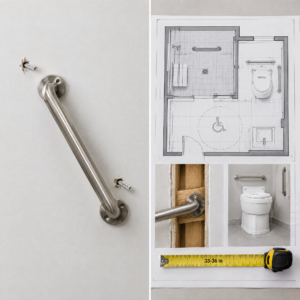
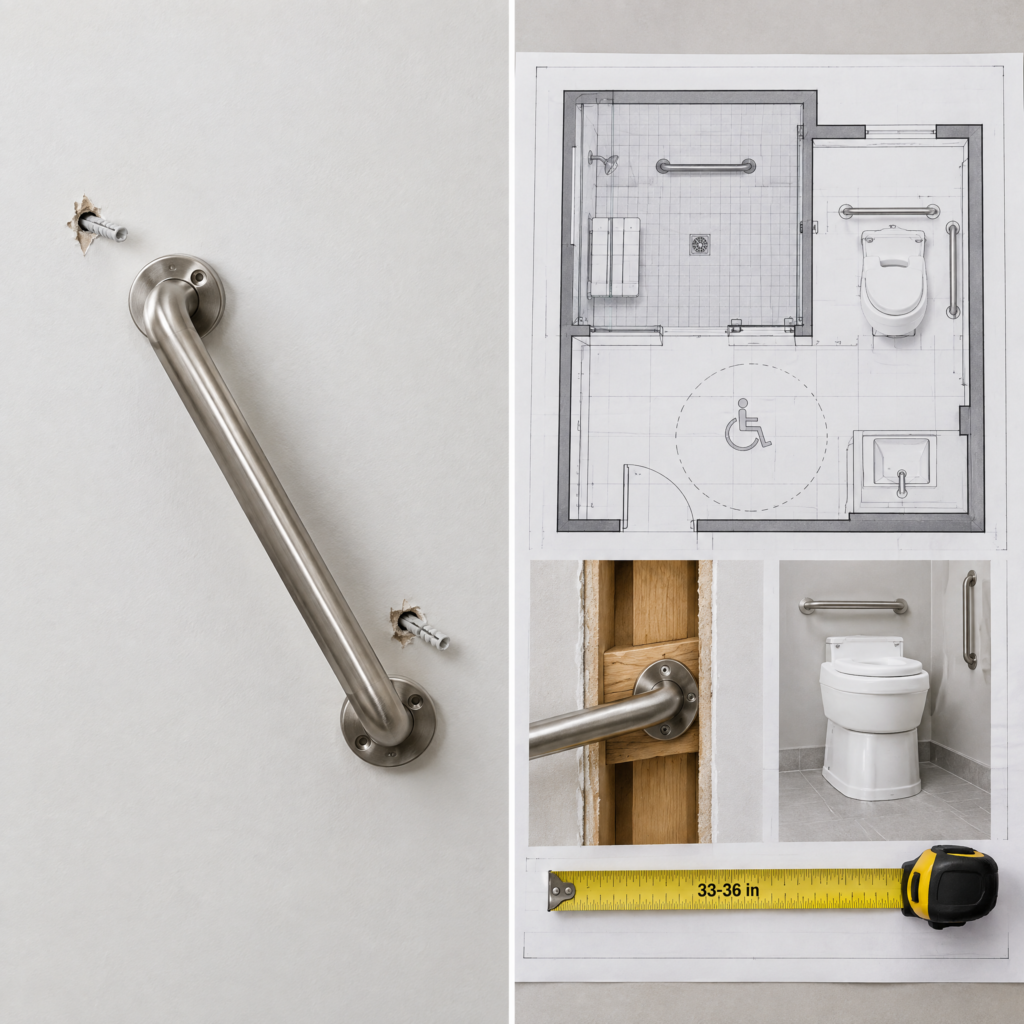
The key phrase is “done right.” Per IRC and ADA specifications, grab bars must be mounted 33 to 36 inches above the finished floor, have a diameter between 1.25 and 1.5 inches, maintain 1.5 inches of clearance from the wall surface, and be rated to support 250 pounds of outward and downward force. That load rating is not a suggestion. A person catching a fall doesn’t ease into the bar — they grab it hard, fast, and at an angle.
Most residential bathroom walls have no structural backing behind the drywall at the locations where grab bars need to go. Screwing a bar into drywall alone — even with the best anchors — creates a serious hazard. Under a 250-pound load, drywall anchors pull through. The bar comes out of the wall, and the fall that was supposed to be prevented becomes a fall with a chunk of wall coming with it.
Why DIY Grab Bar Installations Often Fail
The grab bar kits sold at home improvement stores are not the problem. The installation surface is. Unless a contractor opens the wall and installs wood blocking — solid lumber secured between studs — before closing everything back up, the bar has nothing structural to bite into. That process turns a $15 to $250 parts cost into a $200 to $500 per bar professional job, and that’s before you factor in drywall repair and tile matching if the shower or tub surround needs to be opened.
This is where a lot of families get surprised. They buy two or three bars expecting a simple DIY afternoon. Then they realize the walls are hollow behind the tile, or the studs aren’t where they need bars to go, or the existing tile can’t be drilled without cracking. Suddenly a $150 project becomes a $600 to $1,500 job — and they still only solved two or three points in the bathroom.
Professional installation from a contractor who installs proper blocking runs roughly $200 to $350 per bar, all-in. That’s a fair price for a bar you can actually trust. The problem isn’t the cost. It’s that three bars at $300 each still leaves the threshold, the floor, the entry width, and the fixture heights completely unaddressed.
What a Full ADA Bathroom Conversion Actually Covers
An ADA bathroom conversion treats the bathroom as a system, not a collection of individual hazards. That means looking at every element that contributes to fall risk or accessibility: the shower threshold (ideally zero-entry or no more than half an inch), the floor surface and slip resistance, the doorway width (ADA standard is 32 to 36 inches clear), toilet height (17 to 19 inches to seat, versus a standard 15-inch toilet), fixture placement, and lighting levels.
It also means planning for how mobility needs change over time. Someone who needs one grab bar today may need a walk-in shower and a comfort-height toilet within two years. A full conversion anticipates that arc instead of reacting to it piece by piece. That’s not a sales argument — it’s how AARP’s aging-in-place research frames the value of comprehensive modifications versus incremental ones.
Nationally, a full ADA bathroom conversion averages $8,400 to $9,000, with a realistic range of $3,000 on the low end for a focused accessibility upgrade in a smaller bathroom to $16,000 or more for a complete gut-and-rebuild with premium materials. In the Chicago suburbs, costs track close to that national average, sometimes running slightly higher depending on labor market and material choices.
The Band-Aid vs. Real Fix Framework
Think about it this way. A grab bar kit is the equivalent of putting a non-slip mat on a step — it reduces risk at one precise spot. A full ADA conversion is like rebuilding the staircase so that every step is safer, the railing is solid, and the lighting is adequate the whole way up. Neither option is wrong. But they solve different problems at different scales.
A grab bar makes sense when someone has one specific support need, the rest of the bathroom is otherwise accessible, and the installation is done properly with blocking. It does not make sense as a substitute for addressing a bathroom that has a high curb threshold, slippery floor tile, a narrow doorway, a low toilet, and poor lighting — all of which contribute to falls independently of whether a grab bar is present.
According to the CDC’s fall data, bathrooms are among the highest-risk rooms in the home for adults over 65, and most bathroom falls don’t happen at the one location where a grab bar was installed. They happen at the threshold stepping in, on the wet floor, or at the toilet transition. A grab bar at the shower wall doesn’t help with any of those.
ADA Bathroom Conversion Cost vs Grab Bars: A Straight Comparison
Let’s put the numbers side by side without softening them. Three professionally installed grab bars with proper blocking: $600 to $1,050. A full ADA bathroom conversion: $8,400 to $9,000 on average. The gap is real, and it matters for a household budget.
What the grab bar option buys: three points of support, installed safely, in a bathroom that is otherwise unchanged. What the conversion buys: a bathroom redesigned from entry to fixtures to floor, built to function safely as mobility needs evolve, and done once rather than upgraded in reactive phases over several years.
For families managing a sudden change — a hip replacement, a Parkinson’s diagnosis, a fall that scared everyone — the full conversion often ends up being the more practical financial decision because it eliminates the need to keep returning to the bathroom with more modifications. Every reactive upgrade costs more than planning it together from the start.
When Grab Bars Are the Right Answer
Grab bars are not always the wrong choice. For a relatively healthy person who wants added confidence at one transition point, or for a bathroom that is already largely accessible and just needs supplemental support at the shower, grab bars are appropriate and cost-effective. The goal is always to match the solution to the actual problem.
They’re also sometimes the right first step when a family isn’t yet ready for a full conversion — financially or emotionally. In that case, the most important thing is to install them correctly, with proper blocking, so they’re safe when needed. At Direct Remodeling, we install grab bars with the same structural care we bring to a full conversion, and we can assess whether the bathroom needs more than bars during the same visit.
What an ADA Conversion Includes That Grab Bars Can’t Address
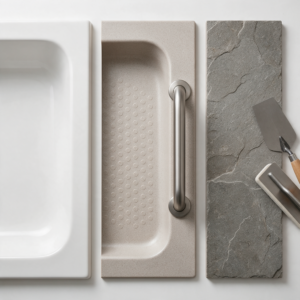
A full senior ADA bathroom remodel typically covers: zero or low-threshold shower entry, slip-resistant floor tile, widened doorway if needed, comfort-height or wall-hung toilet, reinforced walls for current and future bar placement, handheld showerhead on an adjustable slide bar, improved lighting, and a layout that allows a wheelchair or walker to maneuver safely.
Each of those elements addresses a separate failure point. A zero-threshold shower removes the most common trip hazard in a bathroom. Slip-resistant tile reduces wet floor falls. Comfort-height toilets reduce the strain and instability of sitting and standing — which is when a significant number of bathroom falls occur. Grab bars alone touch none of those.
An aging-in-place upgrade packages these elements together and plans them as a system, which also makes the installation more efficient than adding them one at a time over several years.
How Direct Remodeling Approaches This Decision
Every family’s situation is different. Some people genuinely need two grab bars and nothing else. Others are living in a bathroom that needs a complete rethink to be safe for the next decade. We don’t push one path over the other — we assess the actual bathroom, listen to what the person using it needs day-to-day, and give an honest recommendation.
When we install grab bars, we open the wall and install blocking first. That’s not optional. A bar that pulls out of a wall during a fall is worse than no bar, because it eliminates the only safety measure a person reached for. When we do a full conversion, we plan for future needs at the same time, so the family isn’t back in two years replacing something we could have anticipated.
We offer free in-home assessments for exactly this reason — so homeowners and their families can see the scope of what’s actually needed before committing to any dollar amount. The goal is to solve the real problem, whatever that turns out to be.
The gap between grab bar cost and ADA conversion cost is real, and no one should pretend otherwise. What the numbers don’t show is what each solution actually covers — and what it leaves exposed. A grab bar solves one moment in one location. A full ADA bathroom conversion solves the bathroom.For families dealing with a new mobility challenge, the more useful question is not “how do we spend the least right now?” It’s “what does this bathroom need to be safe for the next ten years, and what’s the smartest way to get there?” Sometimes the answer is a few well-installed grab bars. Often, it’s a planned conversion that eliminates the need for repeated reactive fixes.Either way, the work needs to be done correctly — with proper blocking, proper specs, and a contractor who understands what failure looks like. A bar that pulls out of a wall during a fall isn’t a cost savings. It’s the opposite of safety.